
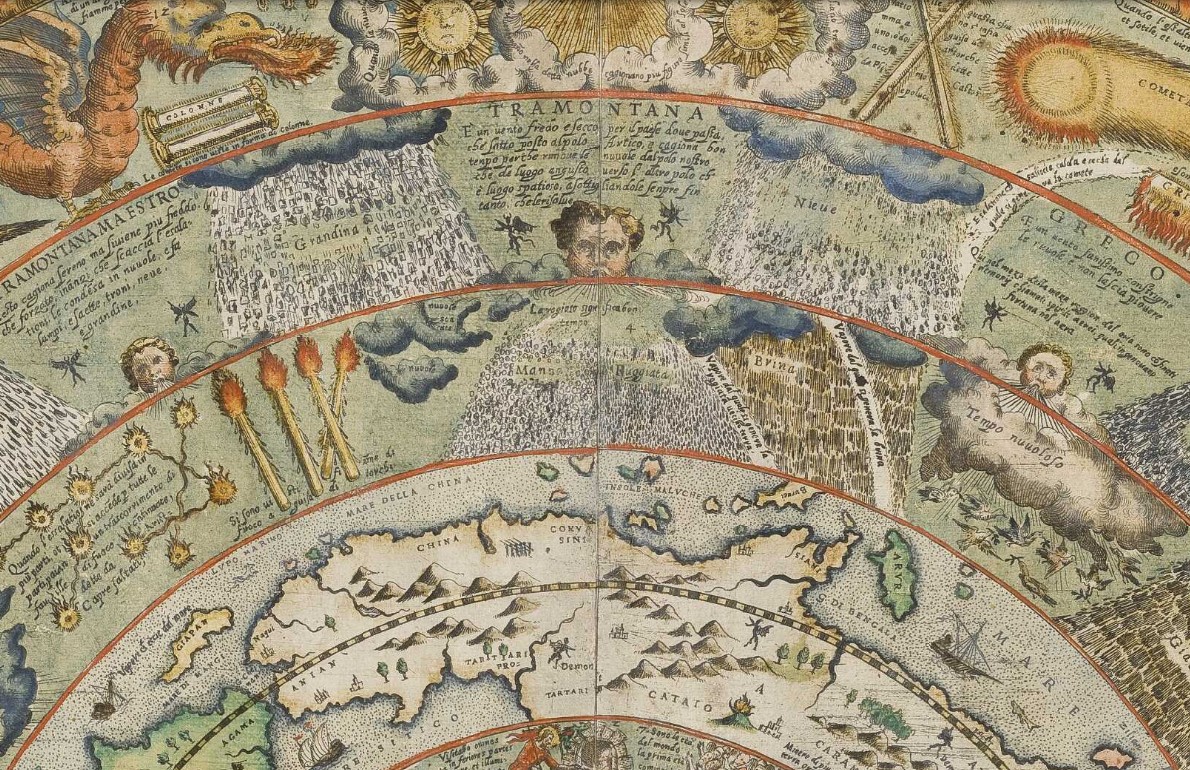

Greetings beautiful souls! It is my honor to share the translation of the 1582 Map of the Earth Construct and Beyond by the cartographer Antonio Saliba of Malta. To explore the map in detail, visit https://kartenspeicher.gbv.de/item/hab_mods_00007813. Note that the content of this map does not necessarily reflect my worldview.
This is a highly informative map packed with texts and figures. To make it easier to follow, I will outline the overall layout of the main texts in Italian and English, starting from the upper left corner to the lower right corner of the map:
– Texts within the orange box is a letter from Antonio Saliba to Marcantonio Colonna, the Viceroy of Sicily, expressing Saliba’s admiration for the Viceroy and offering the map as a token of appreciation.
– The first paragraph starting with “Questa Machina del Mondo,” which translates to “The Machine of the World,” provides an introduction to the Earth construct and the worlds beyond, in relation to the elements, the planets, and their motions.
– The following paragraphs are organized according to the realms and themes indicated in the title.
- Of The Earth and of Hell – Della Terra E Dell’inferno
- Of The Demons and of The Torments Suffered by Souls in Hell – De I Demon Il E Delle Pene Che Patiscono L’anime Nell’inferno
- Of The Limbo of Children – Del Limbo Di Fanciuili
- The Third Circle Is Purgatory – Il Terzo Cerchio È Il Purgatorio
- On The Punishments And The Fire Of Hell And of Purgatory – Delle Pene, Efuoc Dello Inferno, E Del Purgatorio
- On Limbo, Which In Ancient Times Was The Place of The Holy Fathers – Del Limbo Che Antichamente Fu’di Padri Sancti
- In That Part And Place of Hell Where The Soul of Christ Descended – In Cie Parte E Luogo Dell’ Inferno Discese L’anima Di Christo
- The Seven Ages of The World – Sette Sono Le Eta’ Del Mondo
- On The Sea, And On Its Salinity – Del Mare, E Della Sua Salsedine
- On The Air, Its Parts, And The Regions Described By Philosopher – Dell’ Aria, Esve Parti Dette Da Filosofi Regioni
- On The Effects That The Sun Produces On The Earth, The Sea, And The Air: Dell’ Effetto Che Fà Il Sole Nella Terra Nel Mare E Nell’ Aere
- Second Region Of The Air: Seconda Reggione Dele Aria
- Remedies Against Lightning Bolts: Li Rimedii Contra Le Saette
- Third Region of The Air: Terza Reggione Dell’ Aria
- On Comets and other Similar Fiery Phenomena: Delle Comete Et Altre Simili Impressioni Ignite
– After translating the main texts, I will go into the texts within the main image, starting with those in the four corners with the depiction of the suns and the moons, then moving into the inner layers.
In part 1, we start with the map title, the letter, and the introduction.
In part 2, we explored:
- Of The Earth and of Hell
- Of The Demons and of The Torments Suffered by souls in Hell
- Of The Limbo of Children
- The Third Circle Is Purgatory
- On The Punishments and The Fire of Hell and of Purgatory
In part 3, we explored:
- In that Part And Place of Hell Where The Soul of Christ Descended
- The Seven Ages of The World
- On The Sea And On Its Salinity
- On The Air, Its Parts, And The Regions Described By Philosopher
In part 4, we explored:
- On the Effects that the Sun Produces in the Earth, in the Sea, and in the Air
In part 5, we explored:
- Second Region of the Air
- The Remedies Against Lightening Strikes
- Third Region of the Air
In part 6, we explored:
- On Comets and other Similar Fiery Phenomena
In part 7, we will conclude with the main map:
SUN – UPPER LEFT SIDE
When a cloud is found beneath the middle region of the air, of equal thinness or thickness, and it stands opposite the sun, that cloud illuminated by the light of the sun, through the breaking of that light causes those who look at it to see a great circular figure. And this is commonly called the ‘crown of the sun’; the philosophers call it otherwise. If this crown of the sun appears little by little, it signifies fair weather; but from the place where it begins to vanish, it foretells winds; and if it is entirely dark, it signifies rains.
Quãdo siritrova una vuvola sotto la mezza regione dellaer, di ugual lottigliezza, o lpelsezza, e sara incõtro al sole laquele nuvola illuminata dalla luce del sole, fà per rõpitura di quella luce, apparir à quelli, che la guardano una grã figura circolare, e mtõ da la quelle si chiama vol garmcte Corona del sole ifilolafi la chiamano. Alo Sequesta corona di Soariva a poco à poco sgnifica tempo sereno eper onde comincia, di Soarire pronostica venti, e fi se rà tutta negra Significa pioggie.
SUN/MOON – UPPER RIGHT SIDE
When a thin or rarefied cloud is found beneath the middle region of the air, and it is positioned opposite the moon, then, being illuminated by the moon’s light and almost pierced through by that light, it appears, to those who look at it, that a crown or halo forms around the moon, which philosophers who study such things call a “corona.” If this halo begins to dissolve little by little, it signifies fair weather. If it begins to disappear from the side where the winds arise, it foretells winds. If it becomes entirely dark, it signifies rain.
Quando si ritrova una nuvola sotto la mezza regione della eve ugualmẽte sottile, o spe lsa, e sarà incõtro alla luna, la guale illuminata dalle luce della luna, fà per rompilara di quella luce, apparire a quelli, che la mirano una corona in torna alla luna, la quale i filosofi che amano. Alo questa corona sidissoaria apoco, significa buon tempo: e per onde incomincia a disparire alle volve pronostica venti, essi fara tutta negra significa pioggie.
SUN – LOWER RIGHT SIDE
A solar eclipse occurs when the moon is positioned between our eye (the observer) and the sun along a perpendicular line. But in reality the sun is not truly eclipsed, because it is never deprived of its own light. It only seems to us to be deprived of light because the moon places itself between us and the sun and blocks it from view.
Alle hora lara l’ eclipse del sole quando s’interpone la luna trà l’occhio nifoa, et il sole per linea perpendicolar. mà realmente nõ l’eclipsa per che non si priva mai del suo lume: ma anoi par che si prioa. per lo impedimento della luna che s’interpone tra ngi. et il sole
SUN/MOON – LOWER LEFT SIDE
The moon undergoes an eclipse when the earth is positioned between it and the sun in a straight line. Because of this alignment and because of its descent (its place in its orbit), it passes through the earth’s shadow, and once it finds itself within that shadow, it becomes eclipsed. It is deprived of the sun’s light for the short time that it remains there, until it emerges again and recovers the illumination of the sun.
La luna all’ hora si eclipse quando l’interpone la terra trà il sole, e lei per sinea rctia, e per la sua balsezza passa per l’ombra della terra e treuandosi sotto l’ombra s’ eclipse. Si priva dallume del sole per quel poco di tenpo che vi resta ulcita che lara recuperira illumedal sole.
DESCRIPTIONS OF THE 12 WINDS (clockwise from the top at 12 o’clock)
Tramontana
The north wind is a cold and dry wind for the region through which it passes, because its source lies toward the Arctic Pole. It brings fair weather because it drives the clouds away from the pole—where the place is narrow—and pushes them toward the opposite pole, where the space is broad. In doing so, it thins the clouds and disperses them until they dissolve.
È un vento fredo efecco per il paese dove palsa, che lotte posto alpolo Artico, e cagiona bon tenpo per che rimove le nuvole dal polo noltro che de luogo angulto verlo l’altro polo che e luogo spartioso, a lottig liandole lenpre fin tanto che lersolue.
Greco
It is a very slow wind that forces the clouds, and does not let them rain. Here, in the middle of the air’s region, there are confined demons called aerial spirits, which generally bring fortune to the area.
E’ un vento lanilsimo constrigne le nuvole, e non lalcia piovore.
Qui nel mezo della meza reggion del aria sono cõfinati demony chiamati spirit aerei, quali in genemane fortuna nel aera.
Grecole Van Te
This wind, when it comes with force, generates lightning, strikes and causes freezing, but when it comes slowly, it gathers the clouds.
Questo vento quando vien inpetuoso genera lereno, de lecca e fa giaccio ma quando vien lento congrega le nuvole.
Levante
Levante is a certain wind, which is temperate, and very slow, causing light clouds here
È un certo vento, i quale è temperato, et è fanilsimo cagiona nuvole lenza qua.
Sirocco
Sirocco is a wind that brings rain from the west and blows gently.
È un vent, che la piovere nel ponente e sofia lavgamẽte
Ostro Sirocco
It is an unhealthy wind, hot and full of vapors, and it produces clouds and rain
È un vento mal lano, caldo etfumi do, e cagirno nuvole e pioggia.
Ostro
It is a hot and humid wind, unhealthy and pestilential, rainy, for it drives the clouds toward the Antarctic pole—where the region is wide—and toward the Arctic pole—where the region is narrow—constantly compressing them and thickening the vapors, until these dissolve into rain and produce heavy downpour. It brings heavy rains and makes storms at sea; on land it diminishes the vigor of humans and other living creatures, and causes their bodies to swell.
È vento caldo, et humido, mal lano, pstifero piovolo perobe riduce le nuvole al polo, antartico luggo anplio, verlo l’artico luggo ristrotto, cõltrigendole sempre, et ingroftando li vapori linche li risoluino in pioggia pezo genera. Lulgori pioggie e fa tempolta En mare in pedilce le virtu delli buomin et altri viventi ot fa li corpi grani.
Ostro Libeccio
It is a hot and humid wind and causes clouds or rain.
È un vento caldo, et humido e cagiona nuvole, o pioggia.
Garbino
This wind melts the frost, lessens the cold, and brings forth flowers—even in winter in temperate places.
Questo vento disla la brina allenta il fredo, e produce fiori, etiam d’ in verno nelli luoghi temperati.
Ponente
This wind benefits all things; it is the spirit that aids plants in generating, and all things rooted in the earth through it produce fruit
Questo vento favorilce tutte le cole, et e spirits che lerue a in generar, tutte la cole lerde in terra per il guale fanno frutto.
Ponente Maestro
This is a wind that overturns everything it affects, and in some places it uproots trees; it creates clouds in the east but clear weather at noon.
È un vento, che rivolta ogni cola lotto lopra, et in alcuni luoghi splanta l’arbori, e nell’ oriente fa nuvole: ma nel mezzo giorno fa lereno.
Tramontana Maestro
This produces clear weather, but it becomes colder, for before it drives away the vapors it condenses them into clouds and creates lightning, flashes, thunder, snow, and hail.
Questo cagiona lereno ma liviene piu freddo. che forzato, inanzi che lcaccia l’esalationi. Le condesa in nuvole, e fa lampi, e laette, troni, neve e grandine.

Leave a Reply