
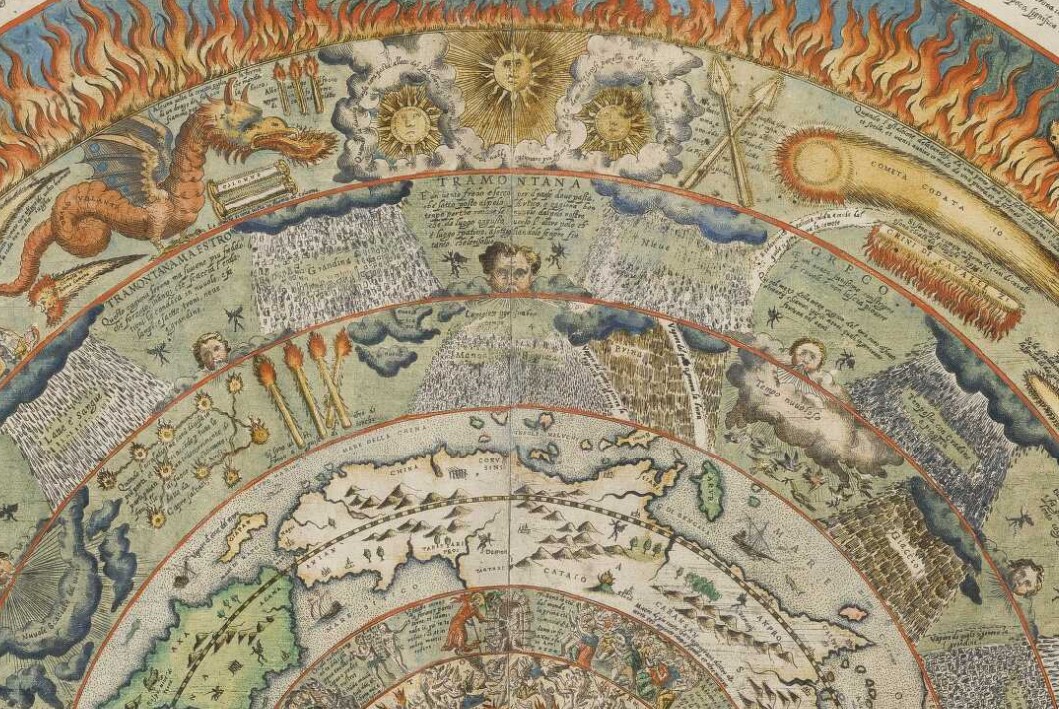

Greetings beautiful souls! It is my honor to share the translation of the 1582 Map of the Earth Construct and Beyond by the cartographer Antonio Saliba of Malta. To explore the map in detail, visit https://kartenspeicher.gbv.de/item/hab_mods_00007813. Note that the content of this map does not necessarily reflect my worldview.
This is a highly informative map packed with texts and figures. To make it easier to follow, I will outline the overall layout of the main texts in Italian and English, starting from the upper left corner to the lower right corner of the map:
– Texts within the orange box is a letter from Antonio Saliba to Marcantonio Colonna, the Viceroy of Sicily, expressing Saliba’s admiration for the Viceroy and offering the map as a token of appreciation.
– The first paragraph starting with “Questa Machina del Mondo,” which translates to “The Machine of the World,” provides an introduction to the Earth construct and the worlds beyond, in relation to the elements, the planets, and their motions.
– The following paragraphs are organized according to the realms and themes indicated in the title.
- Of The Earth and of Hell – Della Terra E Dell’inferno
- Of The Demons and of The Torments Suffered by Souls in Hell – De I Demon Il E Delle Pene Che Patiscono L’anime Nell’inferno
- Of The Limbo of Children – Del Limbo Di Fanciuili
- The Third Circle Is Purgatory – Il Terzo Cerchio È Il Purgatorio
- On The Punishments And The Fire Of Hell And of Purgatory – Delle Pene, Efuoc Dello Inferno, E Del Purgatorio
- On Limbo, Which In Ancient Times Was The Place of The Holy Fathers – Del Limbo Che Antichamente Fu’di Padri Sancti
- In That Part And Place of Hell Where The Soul of Christ Descended – In Cie Parte E Luogo Dell’ Inferno Discese L’anima Di Christo
- The Seven Ages of The World – Sette Sono Le Eta’ Del Mondo
- On The Sea, And On Its Salinity – Del Mare, E Della Sua Salsedine
- On The Air, Its Parts, And The Regions Described By Philosopher – Dell’ Aria, Esve Parti Dette Da Filosofi Regioni
- On The Effects That The Sun Produces On The Earth, The Sea, And The Air: Dell’ Effetto Che Fà Il Sole Nella Terra Nel Mare E Nell’ Aere
- Second Region Of The Air: Seconda Reggione Dele Aria
- Remedies Against Lightning Bolts: Li Rimedii Contra Le Saette
- Third Region of The Air: Terza Reggione Dell’ Aria
- On Comets and other Similar Fiery Phenomena: Delle Comete Et Altre Simili Impressioni Ignite
– After translating the main texts, I will go into the texts within the main image, starting with those in the four corners with the depiction of the suns and the moons, then moving into the inner layers.
In part 1, we start with the map title, the letter, and the introduction.
In part 2, we explore:
- Of The Earth and of Hell
- Of The Demons and of The Torments Suffered by souls in Hell
- Of The Limbo of Children
- The Third Circle Is Purgatory
- On The Punishments and The Fire of Hell and of Purgatory
In part 3, we explore:
- In that Part And Place of Hell Where The Soul of Christ Descended
- The Seven Ages of The World
- On The Sea And On Its Salinity
- On The Air, Its Parts, And The Regions Described By Philosopher
In part 4, we will explore: On the Effects that the Sun Produces in the Earth, in the Sea, and in the Air
ON THE EFFECTS THAT THE SUN PRODUCES IN THE EARTH, IN THE SEA, AND IN THE AIR
From the Sun, and through the motion of the celestial bodies, two kinds—or rather two types—of vapors rise up into the air from the earth, the sea, and from other moist and marshy places. Philosophers call one of them vapor and the other exhalation.
The two kinds of vapors and exhalations
The vapor is warm and moist and is, in potentiality, water. The exhalation, on the other hand, is warm, dry, and smoky; it easily catches fire and is fire in potentiality.
Vapor is the material cause of moist phenomena—such as dew, frost, rime, rain, and similar things—that are generated in the lower region of the air, that is, the part that borders the earth. As we observe there, exhalation is the matter of all fiery phenomena—such as falling stars, comets, fiery chariots, flying dragons, and the like—which appear in the third region of the air, where they are generated and inflamed by the motion of the sphere of fire and of the celestial bodies.
According to the varying disposition and quantity of exhalations, either more or less ignited, these forms appear in the air in many different shapes and images of fiery bodies. Their shapes are named according to their resemblance to comets, bearded, crested, or tailed; fire-horns, dragons, swords, or stars. These impressions are almost all the same thing because they are all made of the same exhalation: smoky, warm, and dry, differing only in intensity. If the exhalation is weak and rare, so that it cannot rise, it remains close to the earth and ignites due to the motion of the air, causing small flames and sparks to appear, sometimes like little torches flying through the air at night in clear weather, as seen in many places in the lower region of the air.
The vapor also rises due to the Sun’s power, sometimes reaching the first and sometimes the second region of the air, but never the third. Once in the second region, it is quickly transformed into clouds, which then bring rain, hail, snow, and similar phenomena, as appears in the second region. However, if the vapor is so weak that it cannot rise, it stays near the earth. When the coolness of the following night arrives, it is immediately transformed into dew, descending to the earth, where it attaches to plants and flowers. This dew, once its moisture is dried by the Sun, becomes a sweet, viscous, slow, and crystalline substance, called manna. If this vapor, which becomes dew, hardens, it turns into frost, similar to well-combed wool or cotton, as seen in the fourth region, and it forms in cold places and times, just as dew forms in warm weather. Both dew and frost are signs of good weather.
Sometimes, the exhalation, trying to rise, cannot pass through the second region of the air due to the cold and it falls back down. When it descends, it encounters another exhalation rising, and the two collide, creating winds—twelve types of winds, as seen at the beginning of the second region, and they must be painted in the third region, close to the earth, since they originate from the earth. Sometimes, this exhalation ignites like a burning torch, sometimes in two forms, as described by the philosophers, Castor and Pollux, as seen in the third region. It is a certain type of fire that moves upwards but stays near the earth, sometimes going toward valleys, rivers, and similar places, and this is due to the thickness of the exhalation from which it is formed. As a result, it attracts those who follow it to the waters and rivers.
Sometimes, this fire deceives humans and birds. Humans think it is a lighted torch, while birds believe it is either pieces of meat or food to eat. This fire is generated from exhalations that rise from humid, warm, and famous places such as hills, valleys, graves, cemeteries, and other similar locations. The exhalation is thin, warm, dry, tenacious, and dense. It heats up and ignites from its own warmth, further increased by the cold of the night, which is its natural condition. It then appears in these places like lights and sparks of fire.
Sometimes, this fire appears above the masts and antennas of ships at night, like little lights, and on the shoulders of sailors, who call it St. Elmo and St. Nicholas. This could be because the saints, through their holiness, are capable of performing greater miracles than this. But naturally speaking, the cause of this fire is the oily exhalation of impurities found inside the ship. As it rises, it moves through the air, escaping the night’s cold, and once heated by the movement of the winds, it ignites and attaches to the ship’s mast or stern, due to the thickness of the tar found there and it continues to burn until all the oily substance is consumed.
This fire is called by the ancients the Star of Helena, a very dangerous sign for sailors, and it always appears as a sign of misfortune. Sometimes, the entire ship seems to catch fire. This happens when exhalations rise from all parts of the ship and ignite in the air, being smoky and oily, and thus the entire ship becomes engulfed in flames, as seen in section 5.
Similar to this fire is the one that scorches and touches hair, fur, and fabric. This fire sometimes arises from the sweat of horses and other animals when they are deeply perspiring, making their manes appear as if they are burning. Vergil mentions it in the story of Ascanius and Lavinia, and Livy mentions it regarding L. Martius.
Sometimes, when the vapor is converted into rain, it descends bitter and red, like blood. This occurs due to the vapor being scorched and not well-cooked by the heat of the Sun. Inside the cloud, a certain sour, bitter, red sweat is generated, coloring the rain and making it bitter. Sometimes it descends sweet, because the vapor is properly processed, and along with it, various kinds of animals and many other wonders fall, such as worms, pieces of meat, blood, milk, stones, wool, clay, iron, frogs, and similar things. These are generated in the air according to the varying disposition of the exhalations. Regulated by the heavens, the air receives diverse forms of animals.
Some say that frogs are generated here below, immediately after a drop of water falls to the earth, when the dust is properly disposed of through the influence of the planets. The vapor takes on a certain heat, proportioned and regulated by the heavens, and more readily forms frogs than other animals. Others say that the fireflies are taken from the earth into the air and then descend to the earth with the rain.
Sometimes, the vapor is sterile and near the earth, and due to its sterility, it cannot be transformed into a cloud but instead turns into a dark fog. This fog descends, signaling fair weather, but when it rises, it causes rain, as it gains strength from the air and is converted into rain.
DELL’EFFETTO CHE FA IL SOLE NELLA TERRA, NEL MARE, E NELL’ARE
Pairiu del Sole eper il moto de i corpi celesti si levano delcõti novo insù nell’aere dalla terra, dal Mare, et d’altri luoghi humidi, è Paludosi, due sorti o’manieve di fumi, l’una e detta vapore da ifilosofi, el’alta esaltate. Il vapore è caldo et humido, et è acqa. in potẽza, e la essalate, e calda, esecha e fumosa; e tosto s’infiama et e fuoco in patẽza, il vapore e ma. delle impressioni humide, come sono Ruggiato, Brina, Manã, Pioggie e simili queli si generano nella Pa. Reggione dell’aire che cõfina cõlaterra, si come si vede in essa, l’esalate, è ma, di tutte le impressioni ignite, come sono Stelle volanti, Comete Carri di fuoco, Draghi volati, e simili, come sivede nella .3.a. Reggione dell’ aria ove si generano, etiui s’imfiamano dette essallationi per lo moto della Sfera del fuoco, e de’ i corpi Celesti, e secõdo in varia dispositione e quantità della essalatiõe, ò più, ò meno accesa, si mostra nell’aria in tante diverse imagini, e forme di corpi ignei; delle cui sembiãze di: verse prẽde il nome. hor di Cometa barbata, hor di Crinita, hor Caudata, hor di Corno di fuoco, hor di Dragho volãte, hor di Spada, hor di Corno, hor finalmẽte di Stella: come si vede al no. Le queli impressioni sono tutte quasi una i stessa cosa, per essere tutte d’una ma. l’essalati one fumosa, calda, e secca nõ sono per ò differenti fra loro, sè nõ secondo il più et il meno. E’sè l’essalatione sarà poca e rara, che non possa salire in sù, rimã quì giu vicino terra, et s’infiama dal moto dell’aria, cagionone varie e diverse fiamette e sẽtille di fuoco et alle volte a guisa di cãdelucce accese che volar si vegono nell’aere di notte, nel tẽpo sereno, si come si vede in piu luoghi nella Pa. Reggione dell aere. Il Vapare ancor si leua per virtù del Sole, hor fin alla pa. et hor fin alla 2ᵃ. Regione dell’aera, e nõ arriva mai alla 3ᵃ guinto che sarà nella 2ᵃ si cõverte subito in nuvole in pioggie, di pioggie in grãdine, in nevi, e simili come appare nella 2ᵃ. Reggiõe, Ma se il vapor sarà poco in modo, che nõ puo salire in sù resta qui giù, e sopra venẽdogli il freddo temperato della notte seguẽte, subito si cõverte in Rugiada, descẽdendo in terra s’atacca all’herbe, et aifiovi, e’ mãgiati da Animali gli amazza opilãdogli il fegato. Questa Rugiada, desiccato la sua humidità dal Sole divien una cosa dolce, viscosa lenta critõda, e si dice Mana Ma se questo vapore per che si cõverte in Rugiada saggiacia, si fa Brina nel modo che è la lana. et la bambace ben pettinata, si come si vede al no. 4. et si genera ne i luoghi e tempi freddi, si come la Ruggiada ne itempi caldi, per o l’una l’altra è segno di buõ tempo. Alle volte la essalatione volendo salire in sù, e nõ potendo pasare la 2ᵃ Reggione dell’aere per essere ella fredda ritorna al basso, e descẽdendo in giù, ricõtra altra che sale in su. ribatẽdosi fra loro cagionano venti che sono dodici: come si vede nel principio della 2ᵃ Reggione per ben che si deano dipignere nel prẽcipio della 3ᵃ che vicino terra, poi che eglino prẽdeno origgine e prẽcipio dalla terra. Alle volte questa esalatione se infiama à guisa d’un torcio acceso, alle volte in due, delte da filosofi Castuo e poluce, come si vede al no. et è un certo fuoco, che si muove in alto et vicino terra, evà alle volte versso le valle, e fiumi, e simili luoghi, e questo per la grassezza della ma. della quale è cõposto, per ò mena acoloro, che lo seguano all’acque, et a i fiumi.
Alle volte questo fuoco ingãna gl’ huomini, et gli vcelli, gli huomini, per che pĩsano che sieno candelucce allumate, gli vcelli, per che pensano che siano, ò pezi di carne, o cibi da mãgiare; questo fuoco si genera dalla essalatione, che si leva dà luoghi humidi, caldi, famosi, come sono, poggi, valli, sepolture, Cimitery, et altri simili luoghi, et essendo detta essalatione sottile, calda, secca, tenace e denza, si riscalda, e si infiama dal calore suo unito in sè, et acresciuto dal freddo della notte, che è suo cõtuarico, et appar nè luoghi predetti a guisa di lumi, e di scintille di fuoco.
Alle volte questo fuoco appare sopra le Gabbie, et Antenne delle Navi di notte, come piccoli lumi, et nelle spalle di marinari, i quali fuogbi dicono essere S. Hermo, et S. Nicola: il che può essere poi che i Sti. in virtù del S. ponno fare miracoli maggiori di questo. Mà parlãdo naturalmẽte, la cagione di questo fuoco è la essalatiõe untuosa delle lordezze, che dentro della Nave si ritruovano uscẽdo fuora si muove nell’aria fuggẽdo il freddo della notte, hor quà, hor là, et essẽdo quella materia untuosa, e fumosa, subito s’infiama per la agitatione de’ venti all’ultima s’attacca, hor calla gabbia della Nave, hor nella poppa, per la grassezza della pece, che ivi si ritrova, e s’alluma, et dimora fin tanto che si cõsuma tutta quella ma. Questo fuoco è chiamato dagli antichi, la stella di Elena, segno pericolosissimo all i marinari, et appare, sempre pa. della fortuna.
Alle volte appare, che tutta la Nave s’abrugia, questo proviene, quãdo da tutte le nave si levano dette essalationi, e s’infiamano nell’aere, essẽdo fumose, et untuose è per il che tutta s’infiuma nel mare al no. 5 . Simila a questo fuoco, e quel, che rade, e tocha i peli, i capelli, et i drappi. Il qual fuoco alle volte si genera dal sudore di Cavalli, e altri Animali, quando sono molto ben sudati, par che i crini lor s’abrugiano. De i capelli dice Verg: d’Ascanio, e di Lavinia, e Livio di L. Martio. Alle volte cõvertito che sarà il vapore in pioggia discẽde amarissima, e di color rosso, come sangue: il che procede per cagion del vapor arsso, e nõ ben cotto dal calor del Sole, dentro la Nuvola si genera un certo sudore solso, amaro, rosso, e in fetta, e colorisce la pioggia di color di sangue, e la fa divenir amara. Alle volte discẽde dolce, perché il vapor sarà ben digiesco: e cadeno insieme, alle volte varie sorti di Animali, e molte altre cose degne di maraviglia, come sono, vermi, pezzi di carne, sangue, latte, sassi, lana, Creta, ferro, Ranocchie, essimili le queli cose, si generano nell aere secõdo la varia, e diversa dispositione della: ma. Regolata dai cieli si ricevano varie, e diversse forme di Animali. Alcuni dicono che le ranocchie si gienerano qui giù, subito che lagoccia d’acqua cade in terra, eri trovãdo la polvere bẽ disposta per virtù di Pianeti, viceve la forma di si fatti Animaletti, per cio che in quella ma. si geneva un certo calore proportionato, e dal cielo regolato à ricever piu tosto forma di ranocchie, che d’altri Animali. Altri dicono che del ti anima lucci sõ presi da terra in aria, di poi discẽdono interra cõ la pioggia, alle volte il vapore sarà sterile, e vicino terra, e per la sua sterilità nõ si può cõvertere in nuvola, mà in nebbia oscura; la quale si discẽde in giù, pronostica bũo tenpo, ma si sugli in sù cagiona pioggia, per che salẽdo in sù riceve forza dall’aria esi cõverte in pioggia.

Leave a Reply