
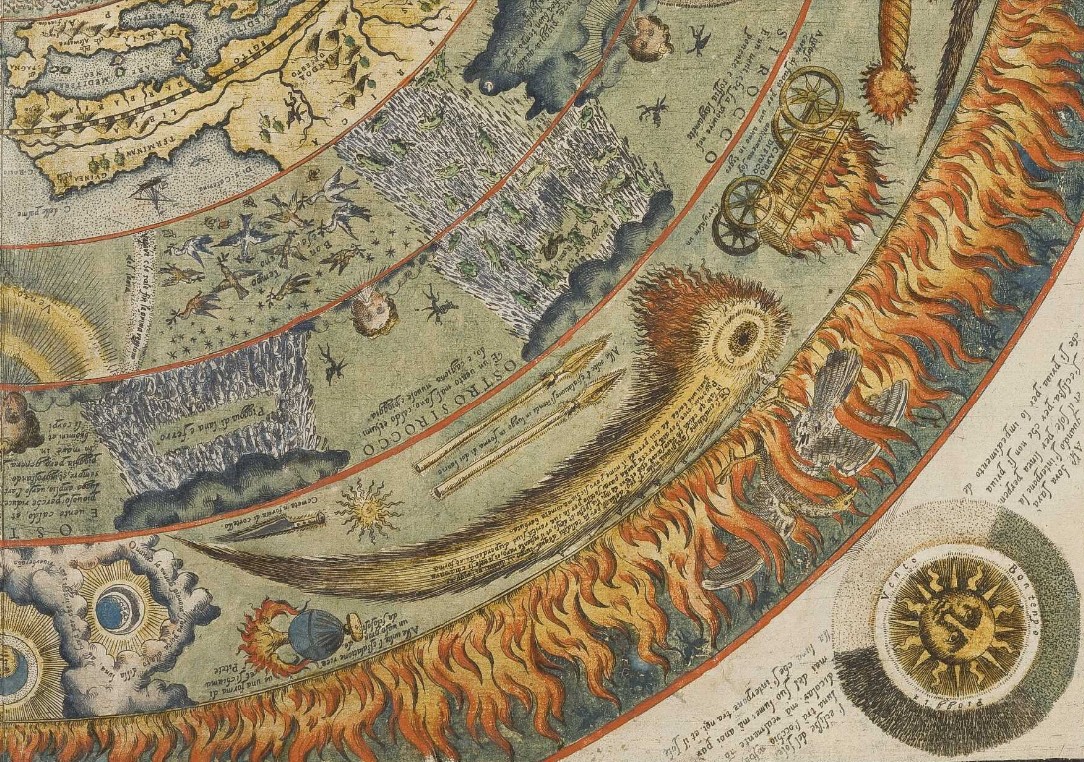

Greetings beautiful souls! It is my honor to share the translation of the 1582 Map of the Earth Construct and Beyond by the cartographer Antonio Saliba of Malta. To explore the map in detail, visit https://kartenspeicher.gbv.de/item/hab_mods_00007813. Note that the content of this map does not necessarily reflect my worldview.
This is a highly informative map packed with texts and figures. To make it easier to follow, I will outline the overall layout of the main texts in Italian and English, starting from the upper left corner to the lower right corner of the map:
– Texts within the orange box is a letter from Antonio Saliba to Marcantonio Colonna, the Viceroy of Sicily, expressing Saliba’s admiration for the Viceroy and offering the map as a token of appreciation.
– The first paragraph starting with “Questa Machina del Mondo,” which translates to “The Machine of the World,” provides an introduction to the Earth construct and the worlds beyond, in relation to the elements, the planets, and their motions.
– The following paragraphs are organized according to the realms and themes indicated in the title.
- Of The Earth and of Hell – Della Terra E Dell’inferno
- Of The Demons and of The Torments Suffered by Souls in Hell – De I Demon Il E Delle Pene Che Patiscono L’anime Nell’inferno
- Of The Limbo of Children – Del Limbo Di Fanciuili
- The Third Circle Is Purgatory – Il Terzo Cerchio È Il Purgatorio
- On The Punishments And The Fire Of Hell And of Purgatory – Delle Pene, Efuoc Dello Inferno, E Del Purgatorio
- On Limbo, Which In Ancient Times Was The Place of The Holy Fathers – Del Limbo Che Antichamente Fu’di Padri Sancti
- In That Part And Place of Hell Where The Soul of Christ Descended – In Cie Parte E Luogo Dell’ Inferno Discese L’anima Di Christo
- The Seven Ages of The World – Sette Sono Le Eta’ Del Mondo
- On The Sea, And On Its Salinity – Del Mare, E Della Sua Salsedine
- On The Air, Its Parts, And The Regions Described By Philosopher – Dell’ Aria, Esve Parti Dette Da Filosofi Regioni
- On The Effects That The Sun Produces On The Earth, The Sea, And The Air: Dell’ Effetto Che Fà Il Sole Nella Terra Nel Mare E Nell’ Aere
- Second Region Of The Air: Seconda Reggione Dele Aria
- Remedies Against Lightning Bolts: Li Rimedii Contra Le Saette
- Third Region of The Air: Terza Reggione Dell’ Aria
- On Comets and other Similar Fiery Phenomena: Delle Comete Et Altre Simili Impressioni Ignite
– After translating the main texts, I will go into the texts within the main image, starting with those in the four corners with the depiction of the suns and the moons, then moving into the inner layers.
In part 1, we start with the map title, the letter, and the introduction.
In part 2, we explored:
- Of The Earth and of Hell
- Of The Demons and of The Torments Suffered by souls in Hell
- Of The Limbo of Children
- The Third Circle Is Purgatory
- On The Punishments and The Fire of Hell and of Purgatory
In part 3, we explored:
- In that Part And Place of Hell Where The Soul of Christ Descended
- The Seven Ages of The World
- On The Sea And On Its Salinity
- On The Air, Its Parts, And The Regions Described By Philosopher
In part 4, we explored:
- On the Effects that the Sun Produces in the Earth, in the Sea, and in the Air
In part 5, we explored:
- Second Region of the Air
- The Remedies Against Lightening Strikes
- Third Region of the Air
In part 6, we will explore:
- On Comets and other Similar Fiery Phenomena
ON COMETS AND OTHER SIMILAR FIERY PHENOMENA
Philosophers have had various opinions about comets. Some have said they are collections of stars in the sky, others have said they are collections of light, and others still have claimed they are one of the seven planets. But Aristotle, in his Meteorology, says that the comet is nothing more than an exhalation ignited in the third region of the air, resembling a star with a tail, or a beard, but appearing in more forms, as Pliny says. Therefore, all of them can be called by this name, and Aristotle himself only mentions two: the crinitus comet and the barbata comet, called Pogonias, which appears when the smoky exhalation ignites in the third region of the atmosphere. Due to the motion of the heavens, sometimes it will be thick and heavy, and will not immediately consume itself but will burn in a fine way, gradually intensifying and igniting anew. It remains bright as long as it burns. It is sometimes seen for eight, ten, or twenty days, or a month or two, depending on how long it will burn, and it always appears outside the Tropics of Cancer and Capricorn, never inside, because the great heat of the Sun would consume its substance.
One appeared in March or April of 1512, red as blood, and soon after, the death of Julius II followed. Another appeared with a human shape and a short yellow tail, and yet another appeared in the shape of a column without a mane. Another took the form of a half-moon, with short rays or tails, resembling flames. A similar one appeared in April of 1521, followed by wars in Rome and the election of Adrian VI, similar to one seen during the reign of Constantine. Another appeared in 1556, on the first day of March, and was very fiery, after which followed the wars of Rome, the Battle of St. Quentin, the wars in Picardy, the retreat of Emperor Charles V, and later his death, as well as the death of Queen Mary of England.
Sometimes comets appear in the shape of a knife, sickle, or sword. One similar to this appeared in 1526, lasting from August 23rd to September 6th, after which there were events in Rome, Florence, Genoa, Pavia, and other cities in Lombardy. It also appears as a star, like the Sun, with a mane, rays, or tails around it, as it did in 1526, from August 23rd to September 6th, after which wars broke out in Florence against the great Cosimo de’ Medici, the arrival of King Francis I of France in Italy, the major battles, the papal downfall with Emperor Charles V, the war with the Turks against the Venetian Lords, and the Christian princes’ league against the Turks.
Sometimes the comet appears in the shape of a dart ready to be thrown, called Aconite. One such comet appeared in 1472, in March, after which there was a great drought, and the springs dried up. At the same time, the King of England, Henry VI and his son were killed, and the Turks ravaged almost all of Hungary.
Sometimes they appear small and pale without tails, in the shape of a sword, and are called Siphia. A similar one appeared in 1530, from late August until mid-September, and was seen in Italy, France, and Germany. Soon after, wars broke out between the Swiss and German citizens, who took to the streets to rob.
Other comets take the form of horns, called Ceratia. Others resemble horse hair. [Note: The text also refers to Josephus in the Jewish War, Book 7, Chapter 12.]”
It says that God once demonstrated a most astonishing comet in the form of a very large sword, which on every side cast fiery rays upon Jerusalem as if to destroy it, and for the space of an entire year before sunset, many fiery chariots and armies of armed men ran through all the regions, crossing the clouds and surrounding all of Jerusalem. Then at last, He showed the punishment worthy of His wrath.
And of recent memory, on November 12, 1577, around five o’clock at night, a Comet of great splendor appeared in the West in the sign of Capricorn and lasted a total of 7 weeks. Soon after followed the death of many Kings, among them the King of Porto Gallo in the Kingdom of Fez, the death of His Highness in Flanders, where shortly before many fires appeared in the air.
By the advice of the Rector Father of the College of Jesus, in Angra, City of Porto Gallo, it is said that on the island of St. George, which is opposite another island at the Port of Gallo in the month of May 1581, there was a great earthquake so large that it sank countless houses. The following day, the earth opened on a mountain near a land called Bele, in five mouths of fire, each not far from the other, from which great flames of fire with very great force issued forth, along with rivers of fire flowing toward the countryside in such a way that it caused great fear and terror among the people, and it dried up and burned the entire region along with all the crops. Turning everything into fire: at the end, they all stopped at a very large mouth, which threw out tiny ashes with the smell of sulfur that covered all men and animals, from which a very high mountain was made, upon which stood prominently like a dark flame of fire held by two fire dragons that sent out from their mouths lightning bolts and smoke of great terror; also came out a great crowd of horns, flocks of starlings, headless bodies of men, animals, and birds, in such a way that they appeared like infernal demons whistling through the air. These, already mentioned visions (kind and curious reader), were true messengers and signs of God’s wrath for sinners, in whom in such a way He has altered their mind that He has shown us these prodigies several times for the harm of His Majesty, who wishes to save and protect from all danger.
FROM S. DETIO SERIO TO THE AUTHOR D. SALIBA.
Saliba, spreading both wings
Of your cultured genius, you have risen to where
The god of Lanno handed his father Jupiter
The fiery arrows against the Giants;
Then you brought the causes, with which
Thunder, lightning, hail, and rain;
And how the comet moves its rays
To give warning of future evils.
Then you observed with divided gloves
Painting and adorning her beautiful veil,
The colorful daughter of Thaumas
Dark night in bright daylight
Guided and escorted you through the wandering world,
Where the ancients take shame and scorn.
DELLE COMETE ET ALTRE SIMILI IMPRESSIONI IGNITE
Ifilosofi sono stati di varie opinioni intorno alle Comete. Alcuni han detto che sono cõgregation di Stelle, nel Cielo, Altri cõgregation di lume, Altri uno di sette Pianeti, mà Arist, dice nella Meteora, che la Cometa altro nõ è, che una essalatione accesa nella 3a. Reggione dell’aria, a guisa d’una stella che abbita la Chioma, nõ raggi lunghi, ò barba, mà per che apparino di piu sortti, come dice Plinio, per questo tutte si ponno chiamare di questo nome, et lo istesso Aristot, nõ fa mentione d’altro che di due cioe, Cometa crinita, e Barbata, detta Pogonias, et allora appare, quando l’essalatione fumosa s`infiama nella 3a. Regie. per ilmoto d’i Cieli, Alle volte sarà viscosa, e grossa, e non subito si cõsuma, e s`infiama nel po. sottilmẽte, e tutta via di poi si và inforzãdoe succendẽdole nuova. ma. infiamabile, si mãtiene luccida fin tanto, che la cõsuma; aviene alle volt che dimova otto, diece di 20. un Mese, doi, quatro piu e meno, secõdo che hauerà ma. da brusciare, e si geneva sempre fuori di Tropici del Cancro, e di Caprisorno, e non gia mai di dentro .per esserui il grã calore del Sole, che ricolue la sua materia, Una ne apparse nel mesa di Marzo, et Aprile de 1512 di color di sangue, sucesse dipoi la morte di Giulio 20. Unaltra con effigia humana cõ la coda nõ molto lunga dicolor giallo, al no. et Unaltra informa di colonna sẽza crini, et Un` altra in forma di meza Luna, co i crini ò raggi breui, a guisã di fiamẽlle. Una simile a questa apparve nel mese di Aprile l’ano 1521 successero la guerre poi di Roma, la monte di Leon. Xo. la eletione di Adriano sesto, simile deuno Colona, cè ne vide sotto l’Imperio di Constantino: et un altra nell’Anno 1556, il po. giorno di Marzo, et fù assai infocato, a cui successero altra volta le guerre di Roma, la rotta di S. Quintino, e quelle guerre di Piccardia la ritirata dello Imperatore Carlo Quinto dal secolo, e poi la morte sua, e la morte della Reina Maria di Inghilterra. Alle volte apparano in forma, di Coltello, di falce, di Spada. Una simile nefu vista el Anno 1526, e durò dalli 23. D’Agosto fin all 6 di settembre: quel che sucesse dopo, lo san Roma, Firenze, Genova, Pavia, et altre Città di Lombardia. Appare ancora aguisa di Stella, del Sole cosi la Chioma, ò Chrini, ò raggi di intorno, come fù Anno 1526, e due dopo dall 23 di Agosto fin all 6 di settembre quel successe dopo lo san Roma, Firenze, Genova, Padua, apparre ancora a guira di Stella, del Sole cosi la Chioma, ò Cirini, ò raggi di intorno, come fù quella, che si vide l’Anno 1538, alli 18 di Genaio, successe dipoi il tumulto in Firẽze contra il gran Cosimo di medicina, la venuta dl Rè Francesco di Francia: in Italia; cõ si grãde esercite, l’ abbacamento del Papa cõ (‘Imperatore Carlo Quinto, cõ il Rè Francesco, la guerra del Turcho contra i Signori Venetiani, la legha di Principi Christiãcõtre al Turolo. Alle volte appare la Cometa in forma d’un Dardo da lanciare, e si chiama Acontie al no. Una simile apparse nel Anno 1472, nel mese di Marzo, successe dipoi una gran secità, che si sicorno i fonti e nel medesimo tempe furono amazzati Ennigo et il suo figlio Doardo Re d’Ingliterra, et i Turchi sacchegiorno quasi tutta l’Ungaria. Alle volte apparino picciole e palide senze raggi, e sono aguisa di Spada chiamata Sifia. Simile a questa fù quella dell’ Ano 1530, et apparsse dal po. di Agosto fin a meze Setembre, et fù veduta in Italia in Franza, et in Germania, indi apoco tempo furno le guerre delli Suizzari et i cõtadini in Germania si misero alla Starada à rubare. Altre an forma di Corno dette Ceratia al no. zo Altre di crini di cavalli della [p: pei al no. 21. Gioseffo de bello Iudaico nel 70. libro a capi. 12.
Dice che Iddio anticanrẽte demostrò una stupẽdissima Comita in modo d’una grãdissima Spada, che per o gni lato gettava raggi di fuoco sopra Gierusalem pa. che l’havesse destrutta, e per spatio d’un Anno intero inanzi il tramõtar del Sole, fece correre per tutte le Reggioni molti Carri di faco, e Eserciti di huomini arimati che traversavano le Auvole, e circõdavono tutta Gerusalem, di poi all’ultimo provò il castigo degno del suo demenito, E di fresca memoria alli 12 di Novembre del 77 circa le cinque hore di notte, apparse una Cometa di grãdissimo splendore in Ponente nel segno di Capricorno, e durò in tutto 7 setimane, appresso di poi seguito la morte di molti Re, fra i quali, quella del Re, di Porto Gallo nel Regno di Fessa, la morte di sua Altezza in Fiandra, ove poco prima apparsero molti fuochi nel aria. Per aviso del Padre Rettore del Coleggio di Giesù, d’Angrà Citta di Porto Gallo, si dice, che nell’Isola di S. Giorgio chè incõtro di una Altra della Portiera ai Porto gallo, nel po. di Maggio del 81, fù un gran terremoto si gande, che abbissò infinite case, nel seguẽte giorno S` aperi la terra sopra un Monte vicino à una terra dette Bele, in cinque bocche di fuoco l’una poco distante dall’altra delle quali uscivano rasi grãdissimi di fuoco cõ impito grãdissimo, in sieme cõ fiumi di fuoco versso la campagã in modo tale, che altra spavẽto, e terror grãde che ha dato alla gente de seccò, e abrugio, tutto il paese cõ tutti gli Armẽti. Cõvertende ogni cosa in fuoco: all’ultimo si ferno tutte una largb’sima bocca, che da se butava cenẽre minutissima cõ puzza di zolfo che per tutto copruano gli huomini e gli Animali, del che si fece un monte altissimo sopra il quale stava eminẽte come una oscura sevea. di fuoco lunga tenuta da due Draghi di fuoco che mãdavano fuora di bocca Saette e fumo di spavẽto grãdissimo, uscivano ancor una grande caterva di Corni schiere di storni, corpi de homini sẽza testa, di Animal, e di vcelli, in modo che parevano demony infernali uislar per l’aria queste, danoi gia dette visioni (benigno e curioso lettore). sono state veri messageri, e nuty della ira di die per i pecari, nri iquali in tal modo hanno alterato la sua mẽte che ciè fatto veder più volte questi prodigy per ganno dũg sua Maiesta che cidia la suggrã eci djenda da ogni pericolo.
F.I.B Theologus deputatus D.Paulus Regius vidit Theologus
Marius Certarius Ineidebat Neapoli Anno 1582.
DEL S. DETIO SERIO ALL’AVTORE D. SALIBA.
Saliba, che spiegando ambe due l’ali
Del colto ingegno, sei salito, dove
Il Dio di Lanno porse al padre Giove
Contr’i Giganti gli infocati strali;
Indi portasti le cagion, con quali
Ilor tuono, hora lampeggia, hor fiocca, hor piova;
Et come la Cometa i raggi muove
Per dar prevaggio alli futuri mali.
Poscia scorgesti con divise guante
Depinge et fregia il suo bel velo udrono,
Lo colorita figlia di Thaumante
Ditenebrosa notte à chiaro giorno
Guidato et scorto havete il mondo errante,
Onde prendan rossor gli antichi et scorno.

Leave a Reply