
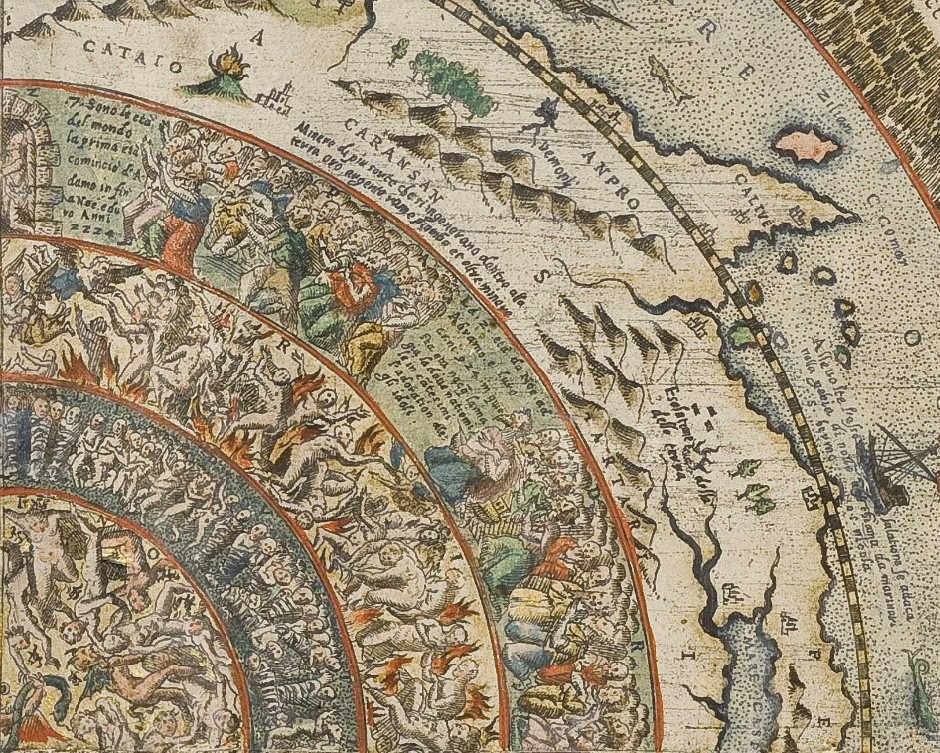

Greetings beautiful souls! It is my honor to share the translation of the 1582 Map of the Earth Construct and Beyond by the cartographer Antonio Saliba of Malta. To explore the map in detail, visit https://kartenspeicher.gbv.de/item/hab_mods_00007813. Note that the content of this map does not necessarily reflect my worldview.
This is a highly informative map packed with texts and figures. To make it easier to follow, I will outline the overall layout of the main texts in Italian and English, starting from the upper left corner to the lower right corner of the map:
– Texts within the orange box is a letter from Antonio Saliba to Marcantonio Colonna, the Viceroy of Sicily, expressing Saliba’s admiration for the Viceroy and offering the map as a token of appreciation.
– The first paragraph starting with “Questa Machina del Mondo,” which translates to “The Machine of the World,” provides an introduction to the Earth construct and the worlds beyond, in relation to the elements, the planets, and their motions.
– The following paragraphs are organized according to the realms and themes indicated in the title.
- Of The Earth and of Hell – Della Terra E Dell’inferno
- Of The Demons and of The Torments Suffered by Souls in Hell – De I Demon Il E Delle Pene Che Patiscono L’anime Nell’inferno
- Of The Limbo of Children – Del Limbo Di Fanciuili
- The Third Circle Is Purgatory – Il Terzo Cerchio È Il Purgatorio
- On The Punishments And The Fire Of Hell And of Purgatory – Delle Pene, Efuoc Dello Inferno, E Del Purgatorio
- On Limbo, Which In Ancient Times Was The Place of The Holy Fathers – Del Limbo Che Antichamente Fu’di Padri Sancti
- In That Part And Place of Hell Where The Soul of Christ Descended – In Cie Parte E Luogo Dell’ Inferno Discese L’anima Di Christo
- The Seven Ages of The World – Sette Sono Le Eta’ Del Mondo
- On The Sea, And On Its Salinity – Del Mare, E Della Sua Salsedine
- On The Air, Its Parts, And The Regions Described By Philosopher – Dell’ Aria, Esve Parti Dette Da Filosofi Regioni
- On The Effect That The Sun Produces On The Earth, The Sea, And The Air: Dell’ Effetto Che Fà Il Sole Nella Terra Nel Mare E Nell’ Aere
- Second Region Of The Air: Seconda Reggione Dele Aria
- Remedies Against Lightning Bolts: Li Rimedii Contra Le Saette
- Third Region of The Air: Terza Reggione Dell’ Aria
- On Comets and other Similar Fiery Phenomena: Delle Comete Et Altre Simili Impressioni Ignite
– After translating the main texts, I will go into the texts within the main image, starting with those in the four corners with the depiction of the suns and the moons, then moving into the inner layers.
In part 1, we start with the map title, the letter, and the introduction.
In part 2, we explore:
- Of The Earth and of Hell
- Of The Demons and of The Torments Suffered by souls in Hell
- Of The Limbo of Children
- The Third Circle Is Purgatory
- On The Punishments and The Fire of Hell and of Purgatory
In part 3, we will explore:
- Of The Limbo That Once Was Of The Holy Fathers
- In That Part And Place of Hell Where The Soul of Christ Descended
- The Seven Ages of The World
- On The Sea And On Its Salinity
- On The Air, Its Parts, And The Regions Described By Philosopher
OF THE LIMBO THAT ONCE WAS OF THE HOLY FATHERS
The fourth and highest circle is called the Bosom of Abraham, a place for the Holy Fathers, and it is the outermost circumference of all of Hell; it is called Limbo because of its extremity. These Holy Fathers were from the Old Testament: and when they died, because of the coming of Christ, they did not ascend to Heaven. Therefore, it was closed off due to the sin of the first parents, but since they had observed the law of the Holy Scriptures, which was taught by the mouth of Moses to the Hebrews, the infinite mercy of God did not want them to descend into Hell, but to this place of Abraham, which means “before belief” or “ascribed to Abraham,” because only to him was the promise made by God, when He said: “In your seed, all the nations will be blessed.”
This Limbo was a dark place, and there was no vision of God there, as Isaiah said: “The people who walked in darkness have seen a great light.” This place was called Hell and the lake. In Zechariah, it also says: “You also, by the blood of Your covenant, have led out your prisoners from the pit,” but they had no knowledge of grace, nor of the teachings of science, nor did they suffer any sensible pain, rather they had quiet and rest, which came to them from their tranquility and their conscience, and from the contemplation of those things they had heard about through faith in this life, that is, from the future redemption of the human generation, and other divine mysteries, which I will leave brief for brevity’s sake.”
DEL LIMBO CHE ANTICAMENTE FU DI PADRI SANCTI
Il Quarto cerchio e supremo si dice il Seno d’Abramo luogo pe.di Padri S(an)cti et è la strema Circõferẽtia di tutto lo Inferno, è detto limbo dalla estremita. Questi P(ri)ncipi S(an)cti furno del Testamẽto vechio: ep che morivno, p(er) del l’avenimẽto di Christo, nõ salirno al Cielo. Per che era chiuso per il peccato de primi parẽti, ma havẽdo eglino osservato la legge del S.rc che per bocca di Mosè era stata insignata agli Hebrei, la infinita misiricordia de Idio nõ volse, che descẽdessero nell’Inferno, ma in questo luogo di Abramo, che significa prẽ di credẽtie s’ascrive ad Abramo, per che a lui solo fù fatta la promissione da Idio, quãdo gli disse in semine tuo benedietur omnes gentes: questo limbo era luogo oscuro, e nõ ci era vision alcuna de Idio, onde diceva Esaya; populus, qui ambulabat intenebris, vidit lucem magnã, questo luogo era chiamato Inferno, et lago. Zaccaria, tu autẽ in sãguine testamẽti tui eduxisti victos de lacusnõ, havevano pero tenebre quãto alla gratia, et à idiscorsi della scienza, nè havevano pena alcuna sẽsibile, anzi soma quiete, e refrigerio, il quale nasceva loro dalla quiete dalla lor cõsiẽza, e dalla cõtemplatione delle cose, che per fede havevano udito in questa vita, cioè dalla futura redenitione della generatione humana, e d’altri mistery divini qual lascio per brevita.
IN THAT PART AND PLACE OF HELL WHERE THE SOUL OF CHRIST DESCENDED
The soul of Christ, separated from the body, descended into the Limbo of the Holy Fathers, to give them, at long last, the gift of the freedom they had so long desired. They cried out continuously without ceasing, saying: Veni Dñe (Come, Lord), as it is written in the Limbo in chapter 1. He descended even to the lowest place, called Hell, and bound Lucifer; and then He comforted those miserable souls who were in Purgatory, purging their sins in the most ardent flames, telling them that their pain would soon be transformed into joy in Heaven, and their sorrow would be turned into gladness: He also illuminated the high place of the Holy Fathers, as it is written above in the Limbo in chapter 2. He penetrated and first illuminated the Holy Fathers who were in Limbo, and immediately He beatified them, drawing them out with Him, and He took with Him some who were in Purgatory and left part of those damned. In those fragments, who were in Limbo, He revealed the divinity, but only the soul of Christ; therefore, they would immediately have been blessed, as the theologians say.
For they saw, indeed, the soul of Christ, but they did not see the fullness of His divinity. Thus, they would have been blessed in Limbo. However, only the soul of Christ descended there, along with His divinity in the lower places with His power and might. Then, Christ brought them the day of His presence according to the prophecy: Populus, qui ambulabat in tenebris (The people who walked in darkness) as in chapter 3. Thus, the Holy Fathers, who were in the darkness of Limbo, saw the light, which was Christ, in the dark night, the bright day—through death, life; in Hell, Paradise. Christ, victorious over death and sin, revealed Himself. Omnes ero mortus (All will be raised) and so the Holy Fathers, from Limbo, were led by Him to the ascension to Heaven. These Holy Fathers were from the Old Testament from different times and ages.
IN CHE PARTE E L’UGO DELL’INFERNO DISCESE L’ANIMA DI CRISTO
L’Anima di Cristo separata dal corpo discese nel limbo dei Padri S(anti), a fare lor cortese duono della libertà tãto tẽpo pa. da essi desiderata, onde gridavano del cõtinuo sẽza mai cessare e dicenão: Veni Dñe, sicome si legge nell limbo al n°. i. discese anco fin al più basso luogo detto Inferno e legò Lucifero: e cõfortò di poi quelle misere anime, che stavao nel Purgato a purgare i lor peccati in quelle ardentissime fiamme, dicẽdole, che questa lor pena presto si cõvertirà in allegreza nel Cielo, tristitio vestra cõvertetur in gaudium: nè illuminò alto. luogo che questo di S(anti) Padri come è scritto sopra nel limbo al n°.z. Penetrabbo et e:primo illuminò i Pri S(anti) che erano nel Limbo, et di subito li beatificò, e trasse seco fuori, ancor parte di quelle aĩe che stavano nel Purgato e parte ne lasciò di danati, nedi quei fratticuli, che stavano nel limbo, avisto la divinità mà solo l’ãia di Cristo: per che subito sarebbono stati beati: come bẽ dicono i Teologi. Viderũt enim Pomũ.i. aiam Christi, sed odorè Pomii Divinitatẽ, eius non viderũt, tunt enim fuisẽt beati, nel limbo. dung solo discese L’aia di Christo. cõ la divinità negli’ altri luoghi piu bassi cõ la sua virtù Potestà, allora Cristo gli porto il giorno della sua presẽza secõdo la Profetia Populus, qui ambulabat intenebris al no. 3 eccosi i Padri St. nelle tenebre del limbo ban visto la luce, che fu Cristo nella oscura notte il chiaro giorno, nella morte, la vita, nell’Inferno il Paradiso che era Christo vitorioso dalla morte e del peccato. Omnes ero morstuer ceneti dung i Pris. Sti. Dallimbo li menò seconel di della ascẽtione al cielo: questi Pri. Sti. Furno del Testamẽto Vechio in diversi tempi et età.
THE SEVEN AGES OF THE WORLD
The first age, from Adam to Noah, lasted 2244 years. The second, from Noah to Abraham, lasted 92 years, and in this age began the rise of magic, sorcery, and divinations by Canaan, who was also called Zoroaster, King of Batro; after the Flood, it lasted 300 years, and at the same time, the worship of idols began. The Gentile people came from Ninus, King of the Assyrians; after the Flood, it lasted 320 years. The third age, from Abraham to David, in this age the written law given by God to Moses began, up until that time the world had been governed by the law of nature, which was: do not do to others what you do not wish done to yourself. They passed from the creation of the world until the giving of the law, 3500 years. This age lasted 942 years. The fourth age, from David to the captivity of the Hebrews in Babylon lasted 485 years. The fifth age, from the servitude of the Hebrews until the Nativity of our Lord and Savior lasted 539 years. The sixth age, from the death of Christ to the day of Judgment, in this age came the false law of the Turks, 621 years. After the death of Christ, this age lasted until the present year, 907, which brings us to the year 1582. The seventh and final age is the one in which we all rejoice in Heaven, forever and ever.
SETTE SONO LE ETÀ DEL MONDO
La prima da Adamo, a Noè, e durò Ani 2244. La secõda da Noè ad Abramo, eduro Ani 92 et in questa età bebbe principio della magia e gli in cãtesimi, e le dovinationi da Camo, che fu detto anco Zoroastro Rè, di Batro: dopo il Diluvio Ani 300. e medesimamẽte comincio l’adoratione degl’ Idoli: et il popolo gentile da Nino Rè degli Assiry: dopo il diluvio Ani 320. la Terza età da Abramo fin a David in questa eta cominciò la legge scritta data da Idio a Mosè, fin a quel’ tempo s`era governato il mõdo cõ la legge della Natura, la quale era di nõ fare, altrui, quello che nõ piaceva à sè stesso: Passorno dalla creatione del Mondo fino a detta legge Ani 3500. questa eta duro, Ani 942. La Quarta età da David fino alla cattività degli Hebrei in Babilonia, durò Ani 485. la Quinta età dalla servitù delli Hebrei fino alla Natività del Salvatore nostro Signore, e durò Ani 539. la Sesta età dalla morte di Christo in sino al di del Giuditio: in questa età hebbe la falsa legge de i Turchi, Ani 62i. Dopo la morte di Christo e durata fino al presẽte Ani 907 che adesso siamo nel Ano i582. la Settima et ultima età e quella che godevemo tutti nel Cielo in secula seculorum.
ON THE SEA AND ON ITS SALINITY
Close to the land by the order of nature, comes the water: of the sea, a cold element, which due to its peculiarities, is higher than the land, which is called so by those who navigate from the land into the high seas, for it seems gradually that the land becomes submerged until, in the end, all its fountains and rivers disappear; they enter and settle in the sea, nor does it ever leave its boundary, as the Ecclesiastical affirms “All rivers enter into the sea, and the sea does not overflow, having established its own limits which it cannot surpass.” And indeed, the sea is ten times greater than the land, just as fire is to air, and air is to the sea, nonetheless; the water of the sea does not cover the land: and therefore God wants for the benefit of living creatures that this part of the inhabited earth remains uncovered, as he said in the Book of Genesis. The waters gather under the sky, and the dry land appears and thus it was made. Because of the heat of the sun, the lighter, sweeter parts of the sea rise up, while the heavier ones remain, and these join together with certain dry, arid, and terrestrial exhalations that descend from the air, and other vapors that rise from the depths of the sea, uniting together they cause the salty sea.”
DEL MARE, E DELLA SUA SALSIEDINE
A presso la terra per ordine della natura viẽ l’acqua: del mare Elemẽto freddo, che per le sua votõdità e più alta, che nõ è la terra, il che siue chivamẽte da qualli, che navigano da terra inalto mare per cio che all’ Sora apoco apoco pare, che la terrasi uada abassãdo fin che intutto spariscerda lei tutte le fontane et i fiumi partẽdosì, entrano e s assõdono nel mare, ne per ò go egli nõ esce dal sou termine, il che afferma l‘Ecle siastico. Omnia flumina intrãt in mare, et mare nõ vetũdat cõstituisti terminos suas, qui preterir nõ potevũt, e cõ tutto, che il mare sia dieci volte piu grãde della terra, come il fuoco dell’aria, e l’aria del mare, nõ dimeno; l’acqa del mare nõ copre la terra: per che Idio vuol per benefitio di vivẽti che questa parte di terra habitata restasse: scoperta, come egli disse nel po. del Genis Raccolgãsi e’acque. che sono sotto il Cielo, et apparisca laterra secca e cossi fu fatte: Per il calor del Sole si levano insù le parti rare e piu dolci dalla supficie del mare, erimãgono le grosse, cõ le queli si cõgiugano alcũe essalationi secbe, aride, e terestri, che dall’ aria descẽdono, et altri vapori che dal profondo del mar surgano, unite in stessa, cagionano il mar salso.
ON THE AIR, ITS PARTS, AND THE REGIONS DESCRIBED BY PHILOSOPHER
Air is a substance that fills every place, and according to Aristotle, it is divided into three parts or regions. The first begins from the Earth and the water and ends where the reflection of the Sun’s rays finishes, after they have passed through the Earth. The second begins where the said reflection ends and finishes by rising upwards, at the summits of higher mountains, such as the Olympus in Thessaly, and others, like the Ato in Macedonia, and the Caucasus mountain; from this height, it extends for about 80 miles. The third region begins from the summits of these mountains upwards towards the Moon and beyond, similar to the height of the fire’s source. These three parts or regions are not only distinct by location but also by quality. It is known that the air’s nature is hot and humid, though it occasionally changes to different qualities due to other accidents. Thus, the first region, which borders the Earth is varied and constant, sometimes hot, sometimes cold, and sometimes temperate, according to the variation of the four seasons of the year. The second region is always cold and humid, as it is separated from the sphere of fire by the higher part and also from the reflection of solar rays from below. It serves as a receptacle and shelter for humid vapors, which continuously rise from the Earth and the sea, and are the material of rain and other similar humid impressions.
DELL’ARIA, ESVE PARTI, DETTE DA FILOSOFI REGIONI
L’aria è corpo che riẽpie ogni luogo, e secõdo Arist: si divide in tre parti, ò Reggioni; la pa. comincia dalla Terra, è dall’acqua e termina dove finisce la riflessione de i raggi del Sole, dopo che per cossa haverãno la terra: la Secda hàprẽcipio dove mãche da detta riffessione, e finisce falẽdo in sù, alla somità de mõti piu alti che almõdo siritrovavano, come sono l’Olimpo in Tesaglia, quellalte, detto Ato in Macedonia, e il mõte Caucaso; che de alteza passano miglia 80. la terza Reggione comincia dalla somità di detti Monti in sù verso la Luna e dialtri simili fin al cõcano del fuoco: Queste trè parti ò dir uogliano Regioni nõ solamẽte sono trà loro di sito distinte, mà ancor di qualità, per cio che sibenetutto l’aere Lisua natura è calda, et umido, nõ dimeno per accidẽte poi viene al aegustarsi altre, qualità; per che laper. Reggione che cõfina cõ la terra, è varia, et in cõstãte, hor calda, hor freda, hor temperata, secõdo la varietà di 4 Stagioni dll’Ano; la Secõda è sẽpre fredda et humida, si per che è distũte dalla sfera del fuoco dalla parte di sù, si ancora dalla riflesfione di raggi solari dalla parte, di giù, e per essere ella ricetacolo, et albergo di vapovi umidi che del cõtinovo salgano dalla terra, e dal mare, che sono materia delle pioggie e, de altre simili impressioni umide.

Leave a Reply