


Greetings beautiful souls,
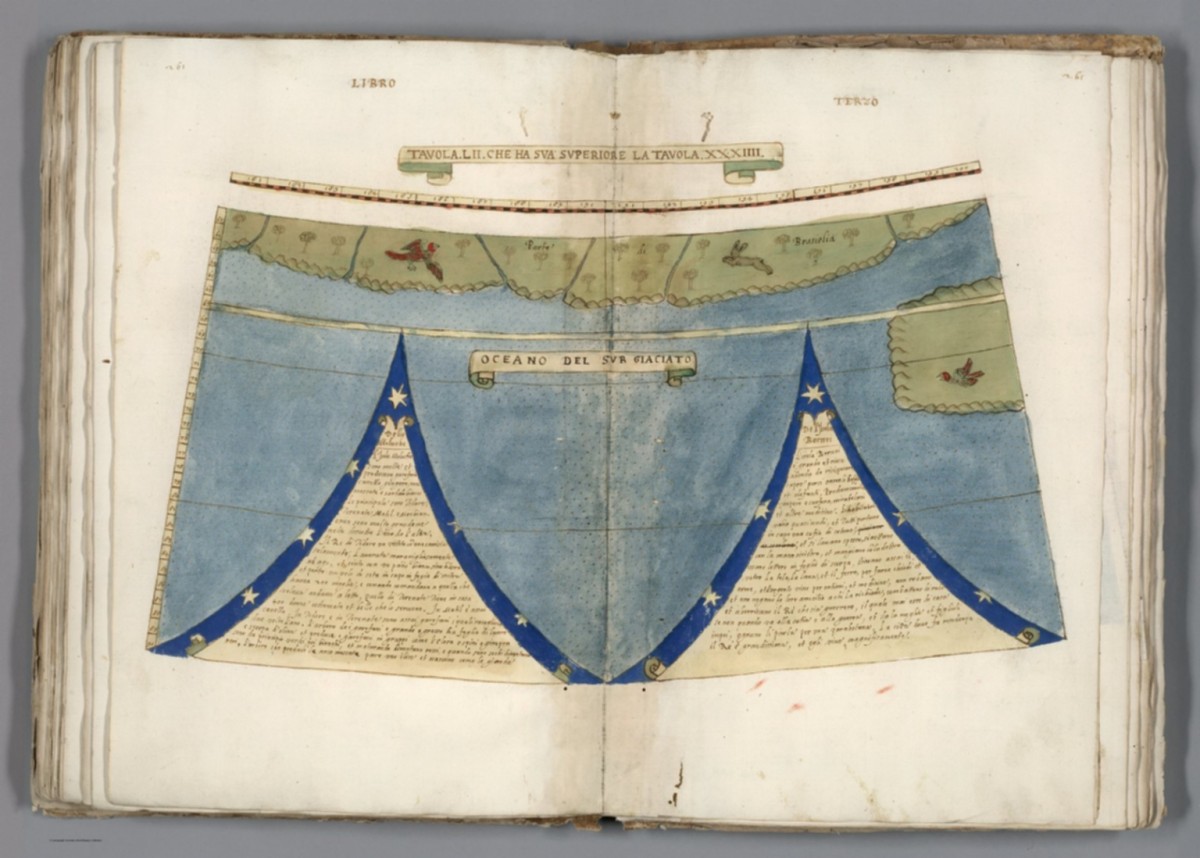
Thank you for your interest in this series. Within each post, I will provide translations of 4 to 5 sheets of manuscripts of the Urbano Monte’s Global Map, created around 1587. For the complete list of the 60-sheet manuscript world map, visit the David Rumsey Map Collection. The manuscripts are of very high quality, allowing for detailed zooming in to closely examine the texts.
In Part 1, we started with the outer texts located in present-day South America, beginning from section 57 and proceeding counterclockwise to section 60 on the Index page.
In Part 2, we continued with sections 43 to 46.
In Part 3, we continued with sections 47 to 50.
In Part 4, we will continue with sections 51 to 54.
These texts offer descriptions of the land, including its inhabitants, animals, and plant life, from an Italian perspective around the 1600s. In addition to the actual map, the Key sheet is also helpful for quickly locating the described areas.
The translations follow a left-to-right order based on the provided images. I used OpenL to translate the texts into English. I rely completely on these tools and welcome corrections, as I myself do not speak Italian. Any errors present are my own.
With love, honor, and respect. 🔥
Nhu

Continuation of the King of China
This King resides in a palace with seven walls around it, and there are always ten thousand men guarding outside taking turns. He is a very just prince, and when one of his ministers or another lord of his kingdom is found to have committed some injustice against his subjects, he has them publicly flayed. He and his people are idolaters, but it is said that they hold the cross in great veneration, although the reason for this is not yet understood, except that perhaps God has planted in them that seed of true faith and religion brought by the Blessed St. Thomas the Apostle, whose body is in Salamina, to make it revive and germinate when it is the incomprehensible will of His service, which is hoped for in Greece, considering the good reputation that the Jesuit Fathers have in this matter and the politeness and civility that these people show.
Seguita del Re de La China
Questo Re sta in un pallazo con sette muraglie inforno et vi stano sempre di fuori alla guardia diecemillia homini mutandosi a vincenda egli è giustissimo principe et quando un suo ministro o altro signore del suo regno è convinto haver fatto alcune ingiustifia a suoi sudditi, egli lo fà scorticare in publico. Egli e suoi popoli sono idolatri ma Tuttavia si dice che Tengono in grandissima veneratione La croce non essendo si ancore intesa la cagione perche lo facia, se non che for si Iddio vi Tien vino quel seme di fede et religion vera portatovi dal Beato sto. Tomaso Apostolo il cui corpo è a salamina per farla rinasere et germo gliare quando a L’ Incomprensibile volunta sua sara servigio, il che si spera in Greve considerando il bon pelo che in cio vi hano i Padri Gesuiti et la politia et civilità che mostrano di se questi popoli.
The Frozen Southern Ocean: Oceano Australe Giaciato
Of the Island Taprobana
Of the Island Taprobana, which today is called Soma, they say it is the largest in the world. The ancients wrote that in it there were almost more beasts than men, who still in form and customs have much resemblance to them, being of shaggy hair, with a horrible voice, blue eyes, and fierce customs, not receiving conversation from foreigners. And despite all this, the men are all dressed in a feminine manner, long and very loose. However, after the Portuguese arrived, they became civilized. The sea around this island shares the fierceness of the men, being so deep that no one can reach the bottom or stop there, and they say there is a great abundance of whales that continuously roam those shores, and they are so monstrous that at first glance they appear to be hills or mountains, and they not only swallow men but also kill them with their poisonous breath, and they have such strength in their breath that they often sink a small boat with whatever is inside.
*Note: Taprobana is an island of Sri Lanka in the Indian Ocean
De LIsola Taprobana
De L’Isola Taprobana che oggi è chiamata soma tra dicono essere La magiore del mondo scrivono gli antichi che in essa erano quasi pin fiere che homini quali ancora nella forma e nei costumi hano molta conformita con loro essendo di chioma irsuta di voce orrenda d’occhi azurini e di costumi ferigni non ricevendo conversatione de forestieri, et con Tutto questo vano li homini tutti vestiti feminilmente Longo e di molta Lassivia. Però dopo che vi sono andati Portughesi si sono Inciviliti. Il mare a torno a quest’ Isola partecipa della fiereza delli homini essendo tant’ alto che niuno vi puo arrivare in fondo ne fermare, et dicono esservi gran copia di balene che di continuo passegiano per quei liti et sono si monstruose che in primo aspetto paiono colli, o monti et non solamente ingolano li homini ma li vcidosio ancora col fiato loro velenoso et hano Tanta forza nello anellito o fiato loro che spesso ingiofiscono una navetta con quello che si Trova dentro.

The Moluccas
The Moluccas Islands are many and produce cloves, cinnamon, ginger, nutmeg, and white sandalwood. The main ones are Tidore, Ternate, Mahl, and Machian, and they are not very large nor very distant from one another. The King of Tidore is dressed only in a wonderfully worked shirt, cinched with a white cloth down to the ground, and wears a silk veil on his head in the shape of a mitre; he has 200 wives, and at dinner, he commands whichever one he wants to go to bed with him. The one from Ternate keeps 400 well-dressed and beautiful women in his house who serve him. In Matil, there is a lot of cinnamon. In Tidore and Ternate, there are many cloves which are harvested twice a year. The clove tree is large and thick, has laurel-like leaves and olive bark, and produces cloves in clusters like holly or juniper; they are green at first, then white, and as they ripen, they turn red, and when dried, they become black. The tree that produces nutmeg resembles an oak and bears fruit like acorns.
Delle Moluche
L’Isole Moluche sono molte et producono garofani canella gengero, noce moscate e sandalo bianco. Le principale sono Tidore, Terenate, Mahl, e Machian, enon sono molto gran de ne molto discoste L’ona da L’ altra. Il Re di Tidore va vestito co una camisia solamente, Lavorata maravigliosamente ad ago, et cinto con un pano bianco sino a Terra et porta un velo di seta in capo in fogia di mitra hauea 200 moglie, e cenando comandava a quella che voleva andasse a letto, Quello di Terenate Tiene in casa 400 donne costumate et belle che lo servono. In Matil e’ assai canella, In Tidore e in Terenate sono assai garofani i quali racogliono due volte L’ano. L’ arboro de i garofani e grande e grosso ha foglia di lauro e scorza d’oliva et produce i garofani in grappi come L’ elera s spini o ginepra sono da principio verdi, poi bianchi, et maturando diventano rossi, e quando sono sechi diventano neri. L’arboro che produce la noce moscate pare uno ilice et nascono come le giande.
The Frozen Southern Ocean: Oceano Del Sur Giaciato
From the Island of Borneo
The island of Borneo is large and rich, abundant in rice, sugar, goats, pigs, as well as buffaloes and elephants. It produces cinnamon, ginger, camphor, mirabolans, and other medicines. The inhabitants go almost naked, and everyone wears a cotton cap on their head;
De L’Isola Bornei
L’isola Bornei e’ grande et ricca abonda de risi, zucaro, capre porci came li bufali t elefanti, Produce canella zenzero e canfora, mirabolani et altre medicine. Li habitatori vano quasi nudi, et Tutti portano in capo una cufia di cotone;

Part of La Patalia: Parte de La Patalia
From the Island of Zubut
The Island of Zubut is very rich and fertile; it produces gold, sugar, and ginger, and makes white porcelain that does not hold poison. Most go naked, paint themselves, and make their mouths and teeth red. The King wears cotton cloths, and on his head a well-crafted cap, around his neck a gold necklace, and on his finger rings of great value. The Queen wears a long cotton dress and on her head a palm hat like a papal mitre. There are fish that fly, and certain birds like crows called Lagane, which perch on the mouths of whales and let themselves be swallowed, and when inside, they eat the heart and kill them. The islanders are idolaters but friends of Christians.
De L’Isola Zubut
L’ Isola Zubut è molto ricca e fertile produce oro, zucaro e zenzero fano porcelana bianca che non sostiene il veneno, La magior parte vano nudi, si ongono, et si fano, La bocca e i denti rossi. Il Rè veste pani di cotone, e in Testa una cu fia benissimo Lavorata, al collo una collana d’oro e in dito anelli di gran pregio. La Regina veste una veste longa di cotone, et porta mi capo uno capella di palma come mitra papale. Vi sono pessi che volano, et certi ucelli come cornachie detti Lagane, Li quali si pongono alla bocca delle Balene et si Lassiano Trangottere, et quando sono dentro le mangiano il core et le ucidono, Li Isolani sono Idolatri ma amici de cristiani.
Part of Brasília: Parte di Brasielia
The King of Spain and the Indies
He rules the East and the West, this Catholic King is said to be obedient to the holy church and is full of holy and perfect knowledge. He draws to Jesus that lost people who were prey to the cursed enemy, and while he seeks salvation for other souls, he gains from God glory and virtue.
Il Rè di spagna et de Le Indie
Domina Loriente et L’ocidente questo chel Re cattolico vien detto egli alla santa chiesa ubidiente è pieno di saper santo e perfetto. Tira a Gesu quella perduta gente ch’era preda al nemico maladetto et mentre al’ alme altrui cerca salute aquista ase da Dio gloria e virtute.
Of Japan
Japan is three times the size of Italy and was discovered by Portuguese merchants in 1543. It is a very healthy and wealthy country. People live for a hundred years and are healthier and stronger; there are no doctors, but they treat themselves with simple remedies they know that are appropriate for ailments. They go to war to acquire lordship and glory. There are sixty-six small kingdoms on the island; they were all idolaters, but now, thanks to God, a large part are Christians. In 1582, four of their princes were sent by their king to recognize the Roman Pontiff and their leader, who was then Pope Gregory XIII. They witnessed his death and the election of Pope Sixtus V, and they visited Milan. They have an olive complexion, small eyes, but they are well-mannered, and as far as can be understood, they are all Christians, and the oldest of them did not exceed twenty years.
Del Giapone
Il Giapone e’ grande come Tre volte L’ Ittalia fù scoperto da mercanti Portughesi Lano is4s. È paese sanissimo et ricchissimo. Le persone vivono cent’ani e piu sani e robusti, non vi sono medici, ma si curano con simplici che essi conoscono apropriati alle Infirmità, guerregiano per aquistar signorie et gloria, sono nel’ Isola sesantasei Regni picioli, eraho Tutti idolatri, hora & Dio gratia sono gran parte cristiani, et L’ano is8s venero quatro de loro principi mandati da loro Regia riconoscere Il Romano Pontefice & loro capo, che era allora. Papa Gregorio decimo fertio, videro La sua morte, et la creatione di Papa xisto quinto, et venero a Milano, sono di colore olivastro, hano li occhi picioli pur sono di bella creanza et per quanto si puote comprendere Goni cristiani, et il magior di loro no passava vinti am.
The Frozen South Sea: Mare Del Sur Giaciato

Of Quivira
The land of Quivira is flat. There are trees and stones. The men dress and wear shoes, the women delight in having long hair, and they cover their heads and their shameful parts; they have no wheat bread. Their main food is meat, which they often eat raw, either by custom or due to a lack of firewood. They eat the fat raw as they take it from the ox, and they do not boil meat, nor do they have pots, but they roast or heat it over the fire made of ox dung. They move from place to place directly to pastures. Their oxen have a hump on their shoulders and have more hair from the middle forward than from the middle backward; that hair is fine wool. They run like horses; the owners have no other wealth, and they live and dress from them. There are also other animals as large as horses, which, because they have horns and fine wool, are called steers. There are also dogs that, when they move with the flocks, carry goods on their backs.
De Quivira
Il Paese de Quivira è piano. Seng’ arbori e pietre. Li homini si vestono et calciano dico io, le done si dilettano haver longhi li capelli, et si coprono il capo et le parte vergognose di coio, no hano pane di grano alcuno, La lor principal vivanda e carne, la quale mangiano le pui volte cruda, o per costume o per mancamento di legne, mangiano il sevo crudo si come la cavano dal bue, et non a lessano carne, ne hano pignate, ma l’arosticono o scaldano al foco di stera di bue, vano da loco a loco dreto a pascoli, Li suoi boui hano uva gobba sopra la spalle, et hano pui pelo dal mezo innanzi che dal mezo indreto, qual pelo è Lana fina, corrono come cavalli, i patroni non hano altra richezza, et de quelli vivono e vestono, vi sono ancora altri animali grandi come cavalli, quali per che hano corni, e lana fina chiamano castrati, vi sono anco cani che quando mutano loco con i gregi li fano portar roba sopra. La schena.
From Xalisco
Nugno de Guzma conquered Lanoiszi Xalisco and called it New Galicia for being a very harsh region and the people very strong. He built there a chapel to match the name with that of Spain, the people of Guadalajara because he was born in that part of Spain. They dress in a way that women wear to their feet, the men wear short cloaks. The women throughout this Kingdom are very well-disposed and beautiful, the men are strong and warlike. The lords and captains do not carry weapons in war except for certain sticks with which they beat those who do not fight or who disband or do not follow the order. When there is no war, they practice archery; they are very skilled archers. The land is fertile and rich in silver, wax, and apples; they worship idols, eat human flesh, and have other very terrible sins, although Spaniards live there.
De Xalisco
Nugno de Guzma conquistò Lanoiszi xalisco et la chiamò nova Galitia per essere regione asprissima et La gente fortissima, vi edificò co inpostella, per che conformasse il nome con quella di spagna, populo Guadalagiara per che lui era natino di quella di spagna, vestono. Le done fino ai piedi, Li homini vano con mantelli corti, La done quasi in tutto questo Regno sono dispostissime et belissime, Li homini gagliardi et bellicosi, Li signori et capitani non portano arme in guerra salvo certi bastoni con li quali battono quelli che non combattono o si disbandano o non servan L’ordine, quando non hano guerra esercitano la catia, sono Gonissimi saettatori. Il paese e fertile, e ricco d’argento cera e mele, adorano li Idoli, mangiavano carne humana et havevano altri pessimi peccati, auranti vi habitassero spagnoli.
Moctezuma, who was the King of Mexico and the West Indies
Of the West Indies and of Mexico, which we now call New Spain, this man was called the King of all other Kings, the richest in treasure and in people, but accursed. When the invincible knight Fernando Cortés made it subject to Charles V, Holy Roman Emperor, the invincible and powerful ruler in every way.
Matezuma che fu Re di Messico et delle Indie occidentali
De L’India ocidentale e di Messico ch’brora da noi la nova spagna è dette fu costui Re d’ogn’altro Re’l piu ricco di Tesoro e di gente maladetta. Quando Fernando cavaglier invitto detto cortes quelle fece sogietta a Carlo quinto Imperator Romano Magno invitto Potente ni ogni piano.

Leave a Reply